



Recently, when discussing non-surgical facial skin tightening treatments, Oligio has been mentioned frequently by both dermatologists and patients who have previously undergone aesthetic treatments.
Many people have tried HIFU, Ulthera, or Thermage but still feel that their face is “not as firm as expected” or that “it was so painful they do not want to repeat it.”
Oligio has therefore emerged as another option for this group, particularly those seeking natural-looking results and a more comfortable treatment experience.
In this article, I will explain Oligio as a doctor speaking with a patient—without advertising or unnecessarily technical language, but with practical information you can use to make a decision.
What Is Oligio?
Oligio is a skin-tightening device that uses Monopolar Radiofrequency (RF) to deliver heat into the deeper layers of the skin, stimulating the contraction of existing collagen and longer-term production of new collagen.
Put simply, Oligio does not mechanically “pull” the skin. It uses precisely controlled heat to remodel the skin’s structure from within.
Medically, an appropriate level of heat causes collagen fibers to contract immediately and stimulates new collagen production over the following weeks.
This is why Oligio produces gradual, natural-looking results without making the face appear stiff or abruptly altering its shape.
In my experience, Oligio belongs to the category of devices that focus on skin quality and skin tightening rather than dramatic lifting.
What Can Oligio Help With?
To answer the question of what Oligio can help with honestly, this device is better suited to treating mild-to-moderate laxity and skin that is beginning to lose structural support than severe sagging.
Oligio’s key strength is making the skin firmer, smoother, and more youthful-looking overall, rather than lifting only specific areas.
Common Results from Oligio Treatment
- Naturally firmer and tighter facial skin
- A more defined facial contour without looking unnatural
- Nasolabial folds and creases appear less deep
- Smoother skin texture and less visible pores
- Skin appears healthier and more elastic
- Helps the face look more V-shaped
In practice, many patients say, “My face has not changed dramatically, but it looks better.” From a medical perspective, this is considered a good result that is safe over the long term.
Which Skin Layers Does Oligio Treat?
One advantage of the Oligio device is its ability to deliver RF energy deeply and evenly into the skin without damaging the surface layer.
The device controls energy and temperature in real time, allowing it to continuously maintain a temperature range that stimulates collagen.
Skin Layers Affected by Oligio
| Skin layer | What happens |
| Epidermis | Protected by the cooling system |
| Dermis | Collagen contracts and the skin becomes firmer |
| Deep Dermis | New collagen production is stimulated |
| Fibrous support structure | The skin gains better structural support |
In my experience, even energy distribution is an important factor in making Oligio less painful and producing relatively consistent results.
How Many Days Does Oligio Take to Show Results?
I answer this question for every patient in the same way: Oligio is not a treatment that produces dramatic immediate results; improvements develop in line with the skin’s natural processes.
Immediately after treatment, some patients may notice slightly firmer skin due to collagen contraction.
However, clearly visible results generally begin to appear after 2–4 weeks and continue improving until around 2–3 months after treatment
This is when the body is actively producing new collagen.
Clinically, I usually explain that Oligio is a treatment whose results look best in the medium term, rather than one intended to deliver rapid results within a few days.
How Long Do Oligio Results Last?
In general, Oligio results last approximately 6–12 months, depending on factors including the skin’s original condition, age, and post-treatment care.
For patients with good skin quality who do not smoke and avoid intense sun exposure, results often last longer than average.
It is important to understand that Oligio does not stop age-related skin deterioration, but it helps “slow” the process and “restore” the skin’s structure for a period of time.
Many doctors therefore recommend repeating the treatment once a year to maintain skin quality over the long term.
In my experience, patients who undergo Oligio regularly often have skin that looks noticeably younger than that of others the same age.
How Many Oligio Shots Are Needed for Good Results?
The number of Oligio shots should not be determined by price alone because the appropriate number depends on the treatment area and each person’s skin concerns.
Too few shots may not produce a clear result, while delivering more shots than necessary does not improve the outcome.
Approximate Number of Shots
| Area | Number of shots |
| Face | 300–400 |
| Face + neck | 500–600 |
| Face + neck + facial contour | 600–800 |
What Should You Consider When Comparing Oligio 600-Shot Prices?
When discussing Oligio 600-shot prices, patients often focus mainly on the numbers. Medically, however, an appropriate price should reflect the quality of treatment.
Factors affecting the price more than many people realize include the doctor’s experience and the treatment protocol used.
In Thailand, prices generally range from the high tens of thousands to the low hundreds of thousands of baht, depending on the clinic.
I usually advise patients to ask clearly, “Who will perform the treatment?” and “Will my skin be assessed beforehand?” rather than looking only for the lowest price.
Is Oligio Good? A Doctor’s View Based on Experience
If asked directly, “Is Oligio good?”, my answer is that it is very good for appropriately selected patients.
Oligio is not suitable for everyone, but it is highly suitable for those who want firmer, smoother skin, natural-looking improvement, and no downtime.
Advantages of Oligio
- Less painful than older RF devices
- No downtime
- Natural-looking results
- Precise energy control
Limitations
- Not suitable for severe skin laxity
- Not equivalent to a surgical lift
- Requires an experienced doctor
How Is Oligio Different from Ultraformer?
This is one of the questions I hear most often in the clinic. Both Oligio and Ultraformer are popular skin-tightening devices, but their mechanisms of action are actually completely different.
Understanding this difference is important because it helps you select a device suited to your actual skin concerns rather than following trends.
Oligio uses Monopolar RF (Radiofrequency), which distributes heat broadly into the deeper skin layers to improve overall firmness.
By contrast, Ultraformer uses HIFU (High Intensity Focused Ultrasound), focusing energy at individual points along deeper lines to lift specific structures.
Medically, I often explain it this way:
Ultraformer = “lifting in columns”
Oligio = “tightening the entire skin surface”
Oligio vs Ultraformer Comparison Table
| Topic | Oligio | Ultraformer |
| Energy type | Monopolar RF | HIFU |
| Type of result | Firm, smooth, natural-looking lift | Targeted lifting |
| Pain level | Low–moderate | Moderate–fairly painful |
| Suitable for | Laxity across the entire face | Localized skin laxity |
| Consistency | High | Depends on technique |
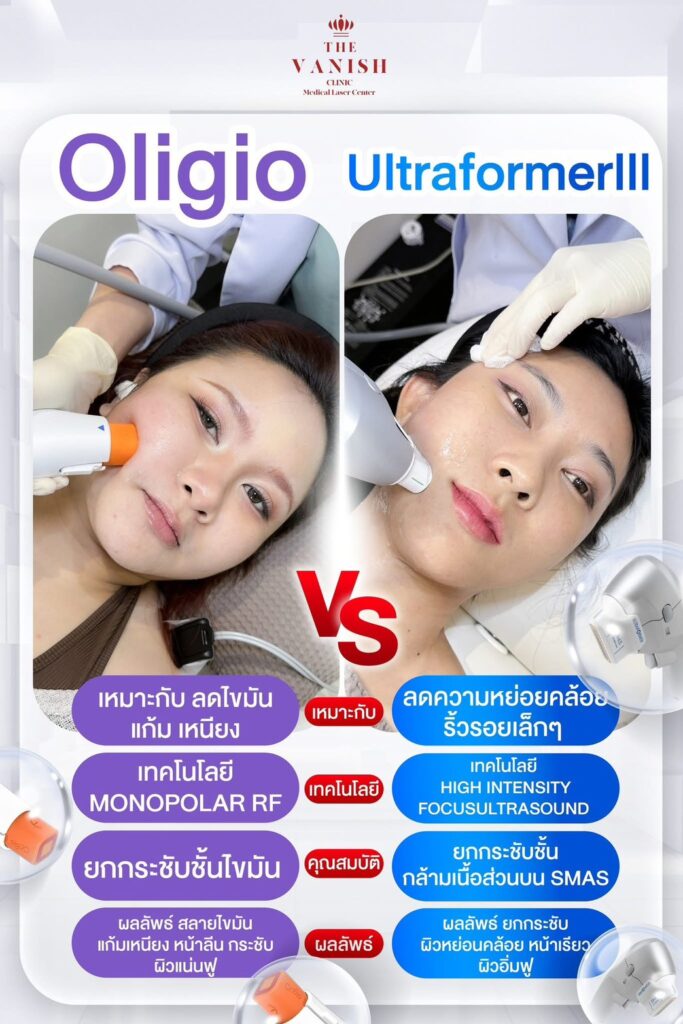
How Are Oligio and Ulthera Different?
Although Ultraformer and Ulthera are both in the HIFU category, many people still frequently compare Ulthera with Oligio.
This is because both are regarded as leading devices in their respective technologies.
Ulthera uses ultrasound energy with real-time visualization, helping the doctor see the skin layers while delivering treatment.
Its advantage is very high precision, making it suitable for lifting deeper structures such as the SMAS.
By contrast, Oligio does not target the SMAS at depth. Its strength lies in improving overall skin quality, making the skin firmer and more youthful-looking.
In practice, I often select Oligio for patients whose skin is beginning to sag but does not yet require substantial lifting, and Ulthera for cases requiring more intensive structural lifting.
Choosing Oligio or Ulthera from a Doctor’s Perspective
- Mild–moderate skin laxity → Oligio
- Obvious laxity and structural drooping → Ulthera
- Want a firm, refined-looking face → Oligio
- Want substantial lifting along the facial contour → Ulthera
In many cases, combining the two devices produces the best results.
A Detailed Comparison of Thermage vs Oligio
When discussing RF, many people think of Thermage first and often follow up by asking:
“If Thermage is already good, is Oligio still necessary?”
The answer is that both use Monopolar RF, but they differ in their generation of technology and the patient experience.
Thermage is an earlier-generation RF device that delivers strong energy and visible results, but with greater pain.
By contrast, Oligio is a newer-generation RF device focused on consistent energy delivery, reduced pain, and a lower risk of skin burns.
Thermage vs Oligio Comparison Table
| Topic | Thermage | Oligio |
| Technology | Earlier-generation RF | Newer-generation RF |
| Pain level | High | Lower |
| Energy control | Limited | Real-time control |
| Suitable for | Thicker skin and those with high pain tolerance | Asian skin |
| Results | Pronounced | Smooth and even |
In my experience, patients who have undergone Thermage and do not want to experience the same pain again often switch to and prefer Oligio.
Choosing Oligio or Ulthera Based on Skin Condition
When choosing a skin-tightening device, you should not ask only, “Which device is more powerful?” Instead, ask:
“What is my actual skin concern?”
A Doctor’s Guide to Choosing
- Thin skin and concerned about pain → Oligio
- Want smooth, subtle results → Oligio
- Moderate–severe skin laxity → Ulthera
- Want SMAS lifting → Ulthera
In clinical practice, I always assess the skin first and explain the advantages and limitations of each device to the patient honestly.
Is Oligio Good Compared with All Skin-Tightening Devices on the Market?
Looking at today’s skin-tightening market overall, Oligio is among the most balanced devices in terms of efficacy, comfort, and safety.
It is not the most powerful device, but it is one that “can be used for most people and produces predictable results.”
From a doctor’s experience, patients returning for repeat treatments and recommending the device to others are important signs that it “works in real-world use.”
FAQ: Questions Patients Ask Most Often About Oligio
Is Oligio Painful?
It is generally less painful than Thermage and HIFU. Most people tolerate it comfortably without general anesthesia or downtime.
How Many Oligio Treatments Are Needed?
For most people, once a year is sufficient, although some may repeat treatment every 8–10 months to maintain skin quality.
Can Oligio Be Combined with Other Treatments?
Yes, and it often produces very good results when combined with:
- Skin booster
- Botox
- Filler in selected areas
Is Downtime Needed After Oligio?
No downtime is required. You can apply makeup and resume your normal activities immediately.
An Overall Medical Perspective on Oligio
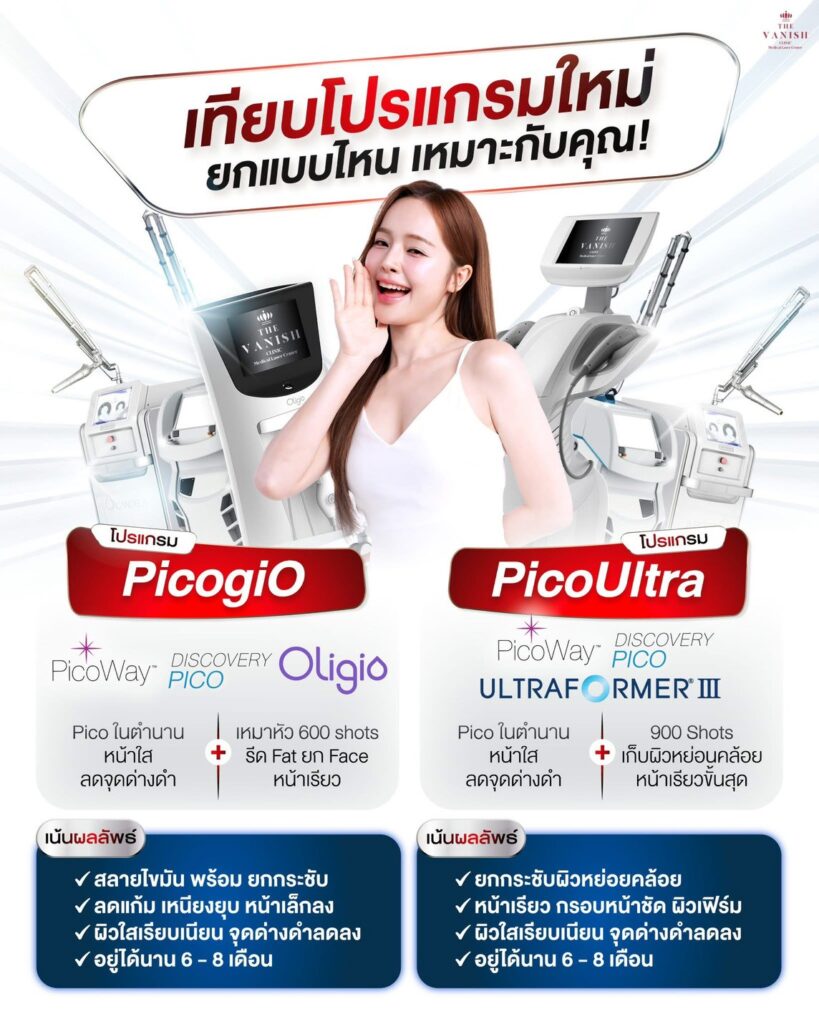
Oligio is a skin-tightening device suited to modern patients who want good, natural-looking results without pain or downtime. When used for the right indications and performed by an experienced doctor, the results often exceed patients’ expectations. The Vanish Clinic also offers the Picogio program, which combines PICO Laser and Oligio to enhance treatment efficacy. The Vanish Clinic also offers Picoultra; their differences are shown in this image.